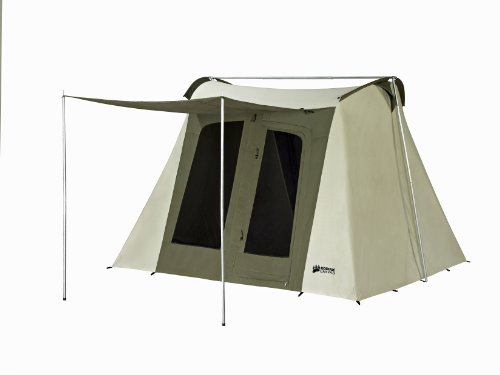
The Kodiak Canvas Flex-Bow Deluxe 10x10 is the tent people picture when they say “canvas tent”: cotton duck walls, a steel frame, a roomy box shape and a weight that only a car can move. It is first in our 2026 camping tent ranking because of how complete it is for fixed-site camping: standing height, two doors, plenty of ventilation and a manufacturer warranty that runs for as long as you own it.
Every detail below comes from Kodiak’s official product page for model 6010 and from Kodiak’s Flex-Bow owner’s manual, and the analysis is our own reading of those documents. Where Kodiak does not give a figure, we do not state one.
What Kodiak Says
According to Kodiak Canvas, the Flex-Bow Deluxe 10x10 (model 6010) offers:
- Capacity: 6-person, in a 10 x 10 ft footprint.
- Canvas: Hydra-Shield 100% cotton duck canvas, 10 oz for the ceiling and 8.5 oz for the walls. Kodiak says the tight weave and silicone finish make it watertight yet breathable, and describes the canvas as PFAS-free.
- Floor: seamless, polyester-reinforced 16 oz vinyl, described as heavy-duty and puncture resistant.
- Frame: 1-inch galvanized steel tubing plus 3/8-inch solid spring steel Flex-Bow rods that keep the tent taut.
- Height: a 6 ft 6 in ceiling with steep walls for stand-up, walk-around room.
- Openings: two large D-shaped doors (front and back) with #10 YKK zippers, four windows with no-see-um mesh and two funnel-flow vents.
- Awning: a 72 x 78 inch awning for shade and a covered entry.
- Storage: a customizable gear loft, pocket organizers and a mesh bag organizer, plus a strap-and-cinch storage bag.
- Stakes: heavy-duty 12-inch steel rod stakes and stainless steel wire stake loops.
- Weight and size: a pack weight of 68 lb, which includes 6.5 lb of stakes. The tent packs at 30 inches long by 13 inches in diameter and the poles at 50 inches by 5.5 inches.
- Warranty: a lifetime limited warranty.
The manual’s component list for the 10x10 shows 18 twelve-inch metal stakes, four spring rods, two upright poles, two awning poles and two adjustable guylines. The strap-and-cinch bag, organizers and gear loft come with the Deluxe and VX versions, while basic models have a zippered bag.
What the Canvas Design Means in Practice
Cotton canvas behaves differently from the nylon and polyester used in most modern tents. Kodiak says its Hydra-Shield canvas is breathable, which is how it aims to reduce condensation and mugginess. Kodiak’s manual adds that condensation depends on the difference between inside and outside temperatures and on humidity, that it can be reduced by venting the tent, and that a ground cloth under the tent can reduce condensation between the floor and a sleeping mat.
The trade-off is care. The manual recommends assembling the tent at home at least once before a trip, then lightly spraying it with water and letting it dry completely, which “seasons” the canvas by shrinking it slightly so that needle holes from the stitching close up. Kodiak also says that not all tents are completely waterproof out of the box and that a new tent may occasionally leak. If that happens, the manual says to treat the affected area with a silicone-based waterproofing product and warns against other types, which it says could affect the canvas’s breathability.
Storage is the other chore. The manual says the tent must be completely dry, inside and out, before it is stored, and that packing it wet or damp, even for a short time, can cause mold that stains and deteriorates the canvas and its water repellency, and can void the warranty. If you have to pack up in the rain, Kodiak says to roll the tent loosely and set it up or hang it to dry as soon as you can. Cleaning is limited to hosing it down and wiping it with a cloth, because soaps and detergents can damage the water-repellent treatment, and bug sprays should not be applied directly to the canvas.
Setup and Anchoring
Kodiak describes setup as an easy, one-person job that takes a few minutes once the tent is staked out. The manual’s sequence is to stake the four corners so the tent is taut and square, then stake the remaining stake loops (14 in total) and two D-rings, join the T-poles and push the spring rods through the sleeves along the roof, and finally raise the tent with the upright poles at each end. The awning is added last with its own poles and guylines.
Two details matter before you buy. First, this tent is not freestanding. The manual states that if it is not properly anchored it will collapse, so you need ground that takes stakes, or a plan for anchoring on hard surfaces. For soft sand or snow, the manual suggests a dead-man anchor: a horizontal piece of wood buried roughly 12 to 18 inches deep with a guyline running to the stake loop. Second, the poles are under tension, and the manual recommends gloves and eye protection during assembly.
Weight and Where It Lives
At 68 lb with stakes, this tent goes nowhere you cannot park beside. The tent bag and the pole bag are packed separately, and the strap-and-cinch bag helps with loading, but the tent is clearly designed for the trunk or truck bed. That matches how Kodiak positions it: a campground tent for families and a base camp for hunting groups.
If you plan to leave a tent up for a long stretch, a canvas model makes more sense than a lightweight nylon one. Kodiak’s manual points to extended-use care guidance on its website for stays of more than three consecutive weeks, so read that before you set a tent up for a whole season.
Winter and Heat
Kodiak labels this tent all-season: usable year-round, but not designed for extreme winter mountaineering or heavy snow accumulations. The owner’s manual repeats that winter camping can be enjoyable in a Kodiak tent but that it is not designed for heavy snow accumulation or snow loads for extended periods, and says to clear snow from the tent on occasion during heavy storms. Kodiak’s page lists two doors, four windows and two vents for airflow.
There is one rule to take seriously if you camp in cold weather. Kodiak’s owner’s manual says the tent is flammable and that you should keep all flame and heat sources away from the fabric. It says never to place a stove, campfire or other flame source in or near the tent, and never to use, light or refuel a stove, lantern, heater or any other heat source inside it. The manual says carbon monoxide poisoning and serious burns are possible, and adds that you must keep adequate ventilation in the tent at all times. We repeat it because canvas tents are popular with cold-weather campers, and it is the single most important instruction in the manual. The manual also tells you to think about falling rocks or tree limbs, lightning, flash floods and strong winds when you choose a campsite, so we make no promise about how any tent will do in a storm.
Who It Suits
- Families who camp at drive-in campgrounds. Standing height and two doors make dressing and moving around easier, and the 10 x 10 ft floor handles a group of sleeping bags. Kodiak rates it for six; for beds and cots, count on fewer.
- Hunting camps and long stays. Canvas and a steel frame are built for tents that stay up for days or weeks.
- Campers who want long-term coverage. The lifetime limited warranty covers defects in materials and workmanship for as long as you own the tent, though the manual excludes normal wear, weather, mold and mildew, burns, UV damage and alterations.
- Anyone who wants quick setup of a large tent. Kodiak’s frame uses spring rods that slide through sleeves, not a maze of clips.
Who Should Look Elsewhere
- Backpackers and anyone who carries the tent. At 68 lb, it is not a hiking tent. See the Big Agnes Copper Spur UL2 mtnGLO for the other end of the spectrum.
- Campers who want freestanding setup. If you often pitch on rock, sand or platforms where stakes will not hold, a freestanding tent such as the NEMO Aurora Highrise 6P is easier.
- Anyone who cannot dry the tent before storing it. A canvas tent packed wet can grow mold, and Kodiak says that voids the warranty.
Bottom Line
The Flex-Bow Deluxe 10x10 is a heavy, durable, high-ventilation canvas tent for people who drive to camp and want to stay a while. Its advantages are standing height, two doors, four windows, a 16 oz vinyl floor and a lifetime warranty; its costs are 68 lb of pack weight, mandatory staking, canvas care and a fire-safety rule that must be followed. If that matches how you camp, the button below shows the current listing, and our ranking lets you compare it with the other tents we picked.
See price on Amazon
See where it lands among the other seven in our 2026 camping tent ranking.
Sources