We earn a commission if you buy through our links, at no extra cost to you.
Comparison
Best Camping Tents for 2026: Our Ranked Picks
Eight camping tents ranked for 2026, from a canvas base-camp tent to ultralight backpacking and four-season models. Specs, trade-offs and who each tent suits.
B By the Best Camping Tent editorial team ·Published
At a glance
Our top pick is the Kodiak Canvas Flex-Bow Deluxe 10x10, a canvas base-camp tent for drive-in sites. For backpacking, choose the Big Agnes Copper Spur UL2 mtnGLO; for families, the NEMO Aurora Highrise 6P; for winter, the MSR Access 2.
A tent is one of the few pieces of camping gear where the wrong choice ruins the whole trip, and the right choice depends almost entirely on how you plan to get it to the campsite. A 68 lb canvas tent is a joy at a drive-in site and impossible on a trail. A 3 lb backpacking tent is a smart choice on the trail and a cramped letdown for a family of five. This ranking covers both ends. We compared the manufacturer specifications of eight tents, from a canvas base-camp tent to a four-season ski-touring shelter, and ranked them for American campers. Every tent has its own profile page with a deeper look at the specs, and each one is linked below.
A note on how to read the order. The ranking puts the most capable and best-built models first, but “capable” means different things for different trips. The top pick is the right answer for a certain kind of camper, not for every camper. If you already know your trip, jump to the Picks by Use section near the end of this page.
How We Chose
We rank tents on published specifications alone and make no claims from personal use. We read what each maker lists on its official product page and compared the figures side by side. Here is what we weighed, in roughly the order it matters.
How it gets to the site. Weight and packed size separate the eight tents more than anything else. Four of them have listed weights under 4 lb and are built to be carried. The other four weigh from about 15 lb to 68 lb and assume a car, a truck or a trailer.
Rated capacity versus real room. A capacity number is a count of sleeping bags on the floor, not a promise of comfort. CORE is the plainest about this: it rates its tent for nine but recommends four people plus gear. We state each maker’s rating and its own comfort note when one exists, and we suggest you plan on fewer people than the number on the tag.
Floor area and peak height. Floor area tells you how much sleeping pad and gear fits. Peak height tells you whether you stand, kneel or sit. Several tents here have a peak of 40 to 43 inches, which means sitting. Others reach 77 to 78 inches, which means walking around.
Freestanding or staked. A freestanding tent holds its shape without stakes, so you can pitch it on a platform or rocky ground and move it before you stake it down. A tent that is not freestanding, like the Kodiak, must be staked to stand at all, according to its manual.
Season rating. Three-season tents are meant for spring, summer and fall. A four-season tent adds stronger poles and less mesh for snow and wind. Canvas is its own category: Kodiak calls its tent all-season but not designed for extreme winter mountaineering or heavy snow accumulations.
Doors, vestibules and ventilation. Two doors mean nobody climbs over a sleeping partner at night. Vestibules keep wet boots and packs outside the sleeping area. Vents and mesh reduce condensation, which every tent produces when warm, damp air meets a cold fabric wall.
Fabric and waterproof ratings. Makers list a hydrostatic head figure in millimeters. A higher number means the fabric resists more water pressure, but it is only one factor next to seam taping, pole strength and where you pitch. We quote the numbers as the makers give them.
Summary Table
#
Tent
Type
Rated capacity
Floor
Peak height
Weight (as listed)
Season
1
Kodiak Canvas Flex-Bow Deluxe 10x10
Canvas base-camp tent, not freestanding
6
10 x 10 ft
6 ft 6 in ceiling
68 lb pack weight with stakes
All-season, not for heavy snow
2
Big Agnes Copper Spur UL2 mtnGLO
Freestanding ultralight backpacking
2
29 sq ft
40 in
2 lb 12 oz trail weight
Three-season
3
NEMO Aurora Highrise 6P
Freestanding family car camping
6
83.3 sq ft
77 in
15 lb 14 oz minimum
Three-season
4
MSR Access 2
Four-season ski touring
2
29 sq ft
42 in
3 lb 10 oz minimum
Four-season
5
NEMO Dagger OSMO 2P
Freestanding backpacking
2
30.6 sq ft
43 in
3 lb 5 oz minimum
Three-season
6
MSR Hubba Hubba LT 2
Freestanding backpacking
2
32 sq ft
40 in
3 lb minimum
Three-season
7
Gazelle T4 Hub Tent
Pop-up hub tent
4
61 sq ft
78 in
30 lb
Not stated
8
CORE 9 Person Instant Cabin Tent
Instant cabin tent
9 (4 plus gear most comfortable)
14 x 9 ft
78 in
37 lb
Not stated
Weights are not defined the same way across brands, so use them to sort tents into classes, not to split ounces. MSR, for example, says it follows ASTM F1934 definitions for minimum and packaged weight.
1. Kodiak Canvas Flex-Bow Deluxe 10x10 — The Top Pick for Base Camps
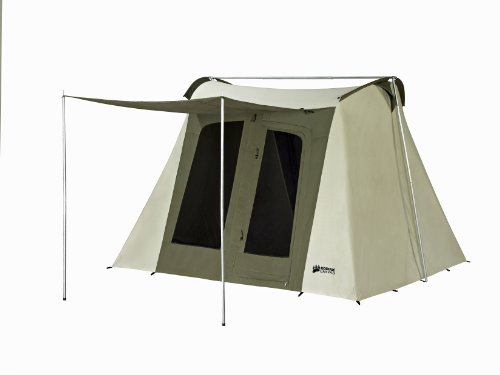
The Flex-Bow Deluxe takes the top spot because it is built for staying put. It is a 10 x 10 ft cotton canvas tent, model 6010, rated for six by Kodiak. The canvas is Hydra-Shield 100% cotton duck, the floor is a seamless 16 oz vinyl, and the frame mixes 1-inch steel tube poles with spring steel Flex-Bow rods that keep the tent taut. The ceiling is 6 ft 6 in, there are two doors with YKK zippers, four windows and two vents with no-see-um mesh, plus an awning.
Canvas breathes, which Kodiak says minimizes condensation and mugginess. It also asks more of you than nylon. The manual says the canvas must be seasoned before the first trip, which means wetting it down and letting it dry so the fibers swell and the weave tightens. The tent is not freestanding: the manual warns it will not stand if it is not properly staked, and it recommends a dead-man anchor in soft sand or snow. The pack weight is 68 lb including 6.5 lb of stakes, so this tent belongs in a car trunk or a truck bed, not on a trail.
Kodiak calls the tent all-season, usable year-round, but not designed for extreme winter mountaineering or heavy snow accumulations. One rule from the manual matters in cold weather: the tent is flammable, and you should never use, light or refuel a stove, lantern, heater or any other heat source inside it, because carbon monoxide poisoning and serious burns are possible. Kodiak backs the tent with a lifetime limited warranty.
Kodiak Canvas Flex-Bow Deluxe 10x10
A canvas base-camp tent with a 6 ft 6 in ceiling and a lifetime limited warranty, for campers who set up once and stay put.
The Copper Spur UL2 mtnGLO is the lightest freestanding two-person tent in the group by Big Agnes’s own numbers: a 2 lb 12 oz trail weight and a 3 lb 3 oz total weight. It is the current mtnGLO version with HyperBead fabric, not the older, discontinued Copper Spur HV UL2, so check the name before you buy. Big Agnes describes it as a three-season, freestanding, ultralight tent with built-in mtnGLO LED tent lights.
The floor is 29 sq ft with a 40 in head height, and each of the two doors opens to a 9 sq ft vestibule that can also be pitched as a 9 sq ft awning. The fabric is 15D nylon on the fly and 20D ripstop, rated at 1500 mm, and Big Agnes says it is made with no intentionally added PFAS. The poles are DAC Featherlite NFL.
The trade-offs are the ones you accept with any tent this light. Two people share a small floor, a footprint is recommended by Big Agnes but sold separately, and the lights run on batteries. It ranks second because it combines low weight, freestanding setup and a feature set no other tent here matches, but it is a backpacking tent first.
Big Agnes Copper Spur UL2 mtnGLO
A freestanding ultralight tent for two hikers who want built-in lighting and two doors at a trail weight of 2 lb 12 oz.
The Aurora Highrise 6P is the roomiest freestanding tent here. NEMO lists a 100 x 120 in floor of 83.3 sq ft, a 77 in peak height, two doors and two vestibules of 23.6 sq ft each. It is a three-season tent for car camping and the backyard, with a 68D polyester canopy and no-see-um mesh, a 1200 mm polyurethane polyester fly and a 150D polyurethane polyester floor rated at 1500 mm.
Freestanding matters at a campground. You can pitch it, check the spot, shift it a few feet and only then stake it. NEMO adds large rain-protected windows, Nightlight Pockets and a printed floor, and says its fabrics meet flame-retardant standards without harmful chemicals. The minimum weight is 15 lb 14 oz and the packed weight is 18 lb 10 oz, which is easy from a car and not realistic on foot.
It sits third, not first, because the Kodiak is the more durable long-stay choice and the Copper Spur is the better carry-in tent. But for a family that wants walk-around height without canvas, this is the most refined pick on the list. NEMO also sells a 4-person size, which is not covered here.
NEMO Aurora Highrise 6P
A freestanding three-season tent with a 77 in peak and two big vestibules, for family trips that start at a drive-in campsite.
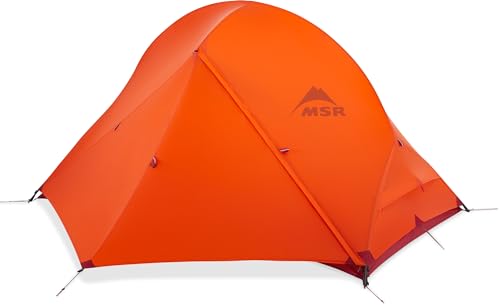
The Access 2 is the only four-season tent in the ranking. MSR built it for backcountry skiers, splitboarders and snowshoers and describes it as lighter than a mountaineering tent but warmer than its backpacking tents. Limited mesh on the body keeps more warmth in, and MSR says the strong frame resists overnight snow loading.
The numbers: a 3 lb 10 oz minimum weight and a 4 lb 1 oz packaged weight, an 84 x 50 in floor of 29 sq ft, a 42 in peak, 17.5 sq ft of vestibule and a 56 cu ft interior. It has two doors, a single Easton Syclone pole, a 20D ripstop nylon fly rated at 1200 mm, and rainfly vents to reduce condensation. MSR says it is suited to less severe conditions such as those near tree line.
It is a specialist. The floor is snug for two people with winter gear, and the thin fabrics need careful handling. Remember that no tent makes cold camping safe by itself. The National Weather Service wind chill chart shows how quickly exposed skin can reach frostbite risk at low temperatures and moderate wind, so plan your layers and your route before you plan your tent.
MSR Access 2
A four-season two-person tent with a 3 lb 10 oz minimum weight, for winter backcountry trips on skis or snowshoes.
NEMO calls the Dagger OSMO its most livable backpacking tent, and the numbers back up the idea of space for the weight. The minimum weight is 3 lb 5 oz and the packed weight is 3 lb 15 oz. The floor is 88 x 50 in, or 30.6 sq ft, the peak is 43 in, and the two vestibules add 12.1 sq ft each. It is freestanding and has two doors.
Updated poles raise the door height by 4 in, the peak by 2 in and the vestibule space by 22%, according to NEMO. The fly and floor are OSMO ripstop, rated at 1500 mm and 2000 mm, made from 100% recycled yarns and bluesign product certified. The Divvy Cube stuff sack lets two hikers split the weight, and the removable Landing Zone tub keeps small gear off the floor.
It lands fifth because the two tents ahead of it for hikers offer either a lower weight or a clearer specialty. Still, for two people who value sitting-up room and storage over the last ounce, it is a strong alternative to the Hubba Hubba and the Copper Spur. A footprint is sold separately, and this is a three-season tent, not a winter one.
NEMO Dagger OSMO 2P
A freestanding two-person backpacking tent with a 43 in peak and a Divvy Cube to split the load between two hikers.
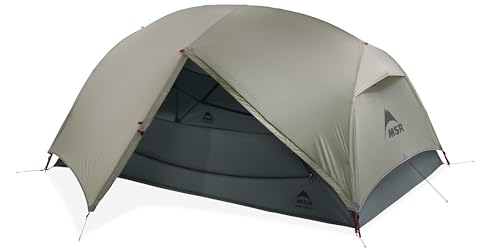
The Hubba Hubba LT 2 has the biggest floor of the four backpacking tents here, with a 32 sq ft interior that MSR says has no taper, so two rectangular sleeping pads fit without overlapping a sloping wall. The minimum weight is 3 lb, the packaged weight is 3 lb 6 oz, and it packs to 20 x 5.5 in.
The peak is 40 in, there are two side-entry vestibule doors with built-in rain gutters, and the vestibules total 16 sq ft. The symmetrical design is meant to make setup quick, the poles are DAC NFL, and the floor, mesh and fly are solution-dyed, which MSR says reduces carbon emissions by at least 80% compared with its previous fabrics. The fly is 20D ripstop nylon at 1200 mm with a PFAS-free coating, and eight Mini Groundhog stakes are included.
It ranks sixth for a narrow reason: its 40 in peak ties the Big Agnes for the lowest in the group, and the tents above it either carry less weight or add something unique. If floor width for two pads is your first concern, though, move it up your own list. The footprint is sold separately.
MSR Hubba Hubba LT 2
A lightweight two-person backpacking tent with a 32 sq ft untapered floor, for hikers who want room for two wide pads.
The T4 is a pop-up tent with a pre-assembled hub frame. Gazelle says it goes from bag to base camp in 90 seconds or less, with no poles to thread. It is listed as sleeping four, with a 94 x 94 in footprint, 61 sq ft of floor, a 78 in center height and a weight of 30 lb.
The shell is 210D Oxford polyester rated at 2000 mm and UV50+, and the 300D Oxford floor is rated at 5000 mm and can be removed for cleaning. There are two D-shaped doors, six mesh windows, a removable rain fly, a removable gear loft and four pockets. Stakes, guylines and an oversized duffle come in the box.
The limits are plain. A 61 sq ft square floor is tight for four adults plus gear, so think of it as a roomy three-person tent or a couple’s tent with space to spare. The pack length is 66.5 in, which takes real room in a trunk. It ranks seventh because the options above it are better built for their specific jobs, but nothing here sets up faster, according to the makers.
Gazelle T4 Hub Tent
A pop-up hub tent with a 78 in center height and a 90-second setup per Gazelle, for couples and small families at drive-in sites.
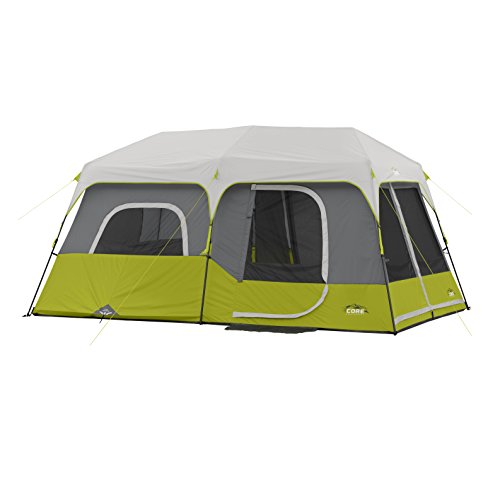
The CORE sits last because it is the entry-level model, not because it lacks space. CORE lists a 14 x 9 ft floor, a 78 in center height and a rating of nine people by industry standard, with 4 people plus gear as the most comfortable. It fits two queen air beds, and it has a room divider so the floor can be split into two rooms.
Pre-attached poles mean the tent is ready in as little as 2 minutes, according to CORE. The fabric is 68D polyester at 1200 mm, and CORE says H2O Block means sealed seams and a fully taped rainfly. It is designed to withstand winds up to 35 mph when properly staked and anchored, and it adds an electrical port, a mesh ceiling and ground vents.
At 37 lb it is easier to carry than the Kodiak but harder than the NEMO. Its fabric and poles are lighter-duty than the tents above it, so stake it well and pick a sheltered site. For a family on a modest budget that camps a few weekends a year, it gives you a big floor and a fast setup at the entry-level end of the ranking.
CORE 9 Person Instant Cabin Tent
An instant cabin tent with a 14 x 9 ft floor and a room divider, for families who want space and fast setup on a modest budget.
Winter. Our guide to camping tents for cold weather explains season ratings and snow anchoring. The MSR Access 2 is the four-season model, and the Kodiak Flex-Bow Deluxe is the all-season canvas option, with the limits Kodiak states about heavy snow. Never use a stove or heater inside a canvas tent, per Kodiak’s manual.
If you drive to camp and stay a while, start with the Kodiak Canvas Flex-Bow Deluxe 10x10, and choose the NEMO Aurora Highrise 6P if you would rather have a freestanding polyester tent. If you carry your shelter, the Big Agnes Copper Spur UL2 mtnGLO, the NEMO Dagger OSMO 2P and the MSR Hubba Hubba LT 2 are the three to compare, and the MSR Access 2 is the one for winter. The Gazelle T4 Hub Tent and the CORE 9 Person Instant Cabin Tent are the two fast-setup options that put a lot of floor on the ground. Whatever you pick, read the maker’s instructions before your first trip, and stake the tent as directed.
Among these eight, the Kodiak Canvas Flex-Bow Deluxe 10x10, the NEMO Aurora Highrise 6P, the Gazelle T4 Hub Tent and the CORE 9 Person Instant Cabin Tent are the drive-in models. The NEMO is freestanding with a 77 in peak; the Gazelle and CORE are the fastest to pitch according to their makers.
What is the lightest tent in this ranking?
On the makers' listed weights, the MSR Hubba Hubba LT 2 has the lowest minimum weight at 3 lb. The Big Agnes Copper Spur UL2 mtnGLO lists a 2 lb 12 oz trail weight, but Big Agnes and MSR do not define weight in exactly the same way, so compare the packaged weights too.
Do I need a four-season tent?
Only if you camp in snow and strong winter wind. The MSR Access 2 is the four-season model here, according to MSR. The NEMO and Big Agnes backpacking tents are listed as three-season, and Kodiak says its canvas tent is not designed for heavy snow accumulations.
Can I use a stove or heater inside my tent?
No. Kodiak's owner's manual says its tent is flammable and that you should never use, light or refuel a stove, lantern, heater or other heat source inside, because carbon monoxide poisoning and serious burns are possible. Treat every tent that way unless the maker says otherwise.
What does a tent's rated capacity actually mean?
It is a count of sleeping bags laid side by side, not a promise of comfort. CORE rates its cabin tent for 9 people but recommends 4 people plus gear as most comfortable, and Kodiak rates a 10 x 10 ft tent for six. Plan on far fewer people if you use cots or air beds.
Do these tents come with a footprint?
Not all of them. Big Agnes, NEMO and MSR each sell the footprint for their backpacking tents separately, according to their official pages. Check what is in the box before you buy.