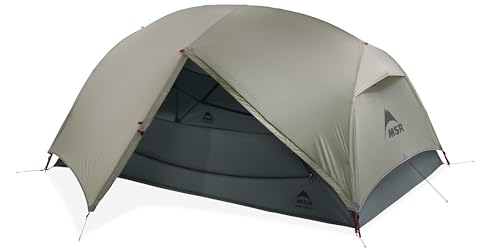
The MSR Hubba Hubba LT 2 is a lightweight, roomy two-person backpacking tent: a minimum weight of 3 lb, a 32 sq ft floor with no taper and two side-entry vestibules. In our ranking it sits sixth, one step behind the NEMO Dagger OSMO 2P, which is its closest competitor and the natural comparison.
Everything in this profile comes from MSR’s official product page on cascadedesigns.com, the site of MSR’s parent company, including its published specification table; the analysis is ours. Where MSR gives no number, we do not guess.
What MSR Says
According to MSR, the Hubba Hubba LT 2 has:
- Capacity: 2 people, with two doors.
- Weight: minimum weight 3 lb (1.36 kg) and packaged weight 3 lb 6 oz (1.54 kg).
- Floor and height: a 32 sq ft (2.95 sq m) floor with no taper and an interior peak height of 40 inches.
- Vestibules: 16 sq ft of vestibule area, across two side-entry vestibules.
- Packed size: 20 x 5.5 inches.
- Poles: a single DAC NFL 9.3 mm pole set.
- Rainfly: solution-dyed 20D ripstop nylon, 1200 mm polyether urethane and PFAS-free silicone.
- Canopy: solution-dyed 20D polyester micromesh and 20D ripstop nylon with a PFAS-free DWR coating.
- Floor: solution-dyed 20D ripstop nylon, 1800 mm polyether urethane and PFAS-free DWR.
- Included: tent body, rainfly, poles, eight Mini Groundhog stakes, guy lines, a stuff sack and setup instructions.
- Made in: Vietnam.
MSR follows the ASTM F1934-98 definitions for tent weights. Minimum weight means the tent body, rainfly and poles only. Packaged weight is everything in the box. MSR also notes that real tents can vary by a few ounces from published weights because of coating and fabric variations, so treat any figure as approximate.
The Floor Plan
Most of the appeal of this tent is on the floor. A true rectangle of 32 sq ft with no taper means modern rectangular sleeping pads sit side by side without the foot end pinching in. MSR does not publish the floor’s exact length and width in the page we opened, so we cannot do the pad arithmetic for you; check the dimensions in the setup instructions if you use wide pads.
Compare that with a 30.6 sq ft floor on the NEMO Dagger OSMO 2P, whose maker gives dimensions of 88 x 50 inches. The MSR is the lighter tent by 5 oz on paper and has slightly more floor, but a lower peak: 40 inches against 43 inches.
Setup and Structure
MSR describes a unified hub-and-pole system with a symmetrical design, so there is no front or back to figure out in a hurry. That symmetry is especially useful when rain is coming and you need the fly on fast. The corner hardware is premium metal, which should hold up better to repeated tensioning than plastic. Eight Mini Groundhog stakes come in the box, and MSR points out that many of its backpacking tents can be pitched with just the rainfly, poles and a footprint in a minimalist setup it calls Fast & Light weight. It does not publish that weight for this tent in the page we opened, so we leave it out.
Ventilation and Weather Protection
The tent body is mostly micromesh, which MSR says provides excellent breathability, minimizes condensation and lets you stargaze on clear nights. The trade-off of a mostly mesh body is airiness: in cold or windy weather you rely on the fly for warmth and wind protection, and MSR does not claim it is a cold-weather design.
The rainfly has two large StayDry doors with built-in rain gutters, which catch drips so they do not land on your gear as you get in and out, plus updated kickstand vents for additional airflow. The seams are taped, and the water-repellent coatings are PFAS-free. MSR’s FAQ says “waterproof” means all external fabric is coated with polyurethane and the seams are watertight out of the bag. Those are ratings of fabric, not a promise that any tent will perform in any storm, so choose your campsite with drainage and wind in mind.
Interior Details
MSR lists a handful of livability features: no-curve doors with zippers that are easy to use with one hand and close to a single point, so you always know where to open the door even in the dark; pockets with cable ports at the corners for headphones and charging cords; large overhead gear loft pockets for headlamps and sunglasses; and an included clothesline for damp clothes. None of these are essential, but they are what separate a comfortable tent from a cramped one after a long day.
Sustainability Notes
All three fabric families (floor, mesh and rainfly) are solution-dyed, which means they use pre-dyed fibers to reduce the water and energy needed for coloring. MSR says that cuts carbon emissions by at least 80 percent compared with its previous fabrics. The water-repellent coatings are PFAS-free. If those points matter to you, they are real selling points here.
Care and Longevity
MSR’s own care guidance applies to this tent. It warns that storing a wet tent for as little as 24 hours in warm weather is likely to start mildew, and that mildew stains are permanent and not covered by warranty. It also says to clean the tent only if necessary, by hand with warm water and a sponge, and never to machine-wash or machine-dry it, because that can strip the waterproof coatings. MSR recommends a footprint under the tent to keep the floor clean and reduce abrasion. Because the tent’s floor is 20D nylon, that is a recommendation worth following.
Pros
- Light. A minimum weight of 3 lb for a 32 sq ft floor, according to MSR.
- Full-rectangle floor. 32 sq ft with no taper suits modern rectangular pads.
- Two doors and two vestibules. No climbing over your partner.
- Fabric choices. Solution-dyed and PFAS-free coatings.
- Quick, symmetrical setup. Useful when weather turns.
Cons
- Peak height of 40 inches. You can sit up but not kneel with room to spare; the NEMO is 3 inches taller.
- Footprint costs extra. MSR sells a Universal 2-Person Large Footprint separately.
- Lightweight materials. 20D fabrics reward careful site selection and care.
- Not built for winter. MSR’s page describes a mostly mesh body for breathability, not a cold-weather design.
Who Should Buy It
The Hubba Hubba LT 2 is for backpacking pairs who want the lowest carry weight that still comes with a roomy floor and two real doors. It also suits bike and kayak trips where packed size matters (20 x 5.5 inches). MSR does not describe it as a snow-load tent, so if your plans include winter camping, look for a tent the maker designs for it.
Who Should Look Elsewhere
If you want to stand inside your tent or bring kids along on a family trip, a larger cabin tent is more practical. If you want the tallest backpacking interior for the weight, compare the NEMO. If weight is no concern at all, car camping tents give far more room.
Bottom Line
The MSR Hubba Hubba LT 2 combines a 3 lb minimum weight, a 32 sq ft untapered floor, two doors, two vestibules and PFAS-free solution-dyed fabrics. Its limits are a 40-inch peak and a footprint you buy separately. The button below opens the current listing on Amazon.
See price on Amazon
The other seven tents we cover are ranked alongside this one in our 2026 camping tent comparison.
Sources