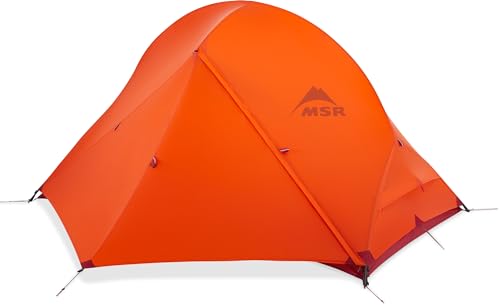
The MSR Access 2 belongs to a narrow and interesting category: a tent built for people who ski, splitboard or snowshoe into the backcountry and want something warmer than a three-season backpacking tent without carrying a full mountaineering shelter. MSR says exactly that on its page: the Access 2 is “lighter than a mountaineering tent, but warmer than our backpacking tents.” It is the only tent in our 2026 lineup built for winter backcountry trips, which is why it ranks fourth: it is excellent at one job and a poor fit for most campers.
The details below come from MSR’s official product page for the Access 2 (MSR is a Cascade Designs brand, and the page is on Cascade Designs’ site), and the analysis is ours. Where MSR gives no figure, we give none.
What MSR Says
According to MSR, the Access 2 is a two-person, four-season ski touring tent. The tech specs list:
- Minimum weight: 3 lb 10 oz (1.64 kg).
- Packaged weight: 4 lb 1 oz (1.86 kg).
- Floor dimensions: 84 x 50 inches (213 x 127 cm), a floor area of 29 sq ft (2.69 sq m).
- Interior peak height: 42 inches (107 cm).
- Tent volume: 56 cu ft (1586 liters).
- Vestibule area and volume: 17.5 sq ft (1.62 sq m) and 17 cu ft (481 liters).
- Packed size: 18 x 6 inches (46 x 15 cm).
- Doors: two.
- Poles: one Easton Syclone pole set.
- Rainfly: 20D ripstop nylon, 1200 mm polyether urethane and silicone coating.
- Canopy: 20D ripstop nylon with DWR.
- Mesh: 10D polyester micro-mesh.
- Floor: 30D ripstop nylon, 3000 mm polyether urethane, with PFAS-free DWR.
- Origin: made in Vietnam.
The box includes the tent body, rainfly, poles, eight Groundhog stakes, guy lines, an easy-load wide-mouth stuff sack and setup instructions. The compatible Universal 2 Person Regular Footprint is sold separately.
What Makes It a Winter Tent
MSR points to several design features. Limited mesh on the tent body keeps in warmth on cold nights. Easton Syclone poles are made of composite materials that MSR says resist breaking in challenging winter conditions. The frame is a central-support design that, in MSR’s words, optimizes interior space and resists snow loading, and the hubbed pole system makes the tent quick to pitch in cold environments. Rainfly vents are there to reduce condensation, and MSR lists a PFAS-free waterproof coating, two doors, two internal pockets and multiple guy points.
The floor figures are worth noticing. The 3000 mm floor rating is double the 1500 mm that some of the other tents in our list use for their floors, which suits snow and wet ground. The 1200 mm fly rating is more typical. MSR does not claim a snow load number, so we do not give one, and nothing on the page promises how the tent will do in a given storm.
Space for Two
At 84 by 50 inches, the floor is a modest 29 sq ft, with a 42-inch peak: you sit up, you do not stand. MSR says the interior is “spacious for delayering,” meaning there is room to take off layers, but the page does not state how many sleeping pads fit. A four-season tent for two is a cramped space where gear lives in the vestibule. At 17.5 sq ft and 17 cu ft, the vestibule is MSR’s answer to keeping skis, boots and packs out of the sleeping area; two doors mean each person can get out without climbing over a partner.
Weight and Packing
MSR defines its weights according to ASTM F1934-98: the minimum weight is the tent body, rainfly and poles, and the packaged weight is everything off the shelf, including stakes, guy lines and the stuff sack. At 3 lb 10 oz minimum, the Access 2 is only slightly heavier than ultralight three-season tents such as the Big Agnes Copper Spur UL2 mtnGLO, whose trail weight is 2 lb 12 oz, but it adds winter features. The packed size of 18 x 6 inches fits inside a ski touring pack. MSR also says actual weights can vary by a few ounces from published specs because of coating and fabric variations.
Fabrics and Care
The canopy and fly are 20D ripstop nylon. A denier number describes the thickness of the yarn, so lower numbers are lighter and finer fabric. That is how MSR keeps the weight down, and it is why you handle this tent with more care than a car camping tent. MSR recommends an MSR footprint under its tents to keep the floor clean and dry and to protect it from abrasion, and says to dry a tent thoroughly before long storage.
On the ground in winter, remember the basics. Pick a spot away from avalanche terrain, tree wells and falling snow. Pack down a platform. Use all the guy points. Kodiak’s owner’s manual for its canvas tent, for example, tells campers in soft sand or snow to bury a dead-man anchor, and the same idea of anchoring to something that will hold applies to any tent in snow.
Cold Weather Notes
No tent makes winter camping safe by itself. The National Weather Service’s wind chill chart shows how fast frostbite can set in as temperature drops and wind picks up, so plan clothing, food and sleeping insulation for the conditions, and know when to turn around.
Keep flame out of the tent. Tent fabric can burn, and a stove or heater in an enclosed space can produce carbon monoxide. Kodiak’s manual for its canvas tent bars stoves, lanterns and heaters inside, citing carbon monoxide poisoning and burns, and the same logic applies to nylon tents. MSR’s page does not discuss cooking in the vestibule, so follow your stove maker’s instructions and keep cooking away from the tent fabric.
Who It Suits
- Ski tourers, splitboarders and snowshoers. That is the audience MSR names.
- Shoulder-season campers near tree-line. MSR describes it as suited to less severe conditions such as those near tree-line.
- Two people who value light weight. The 3 lb 10 oz minimum weight splits easily between two packs.
- Campers who want snow-load resistance in a small package. The central-support frame is built for that.
Who Should Look Elsewhere
- Families and car campers. The 29 sq ft floor and 42-inch peak are too small, and the tent is for two people. See the Kodiak Flex-Bow Deluxe 10x10 for a car-camping approach.
- Summer hikers. Limited mesh means less airflow than a three-season tent; the Big Agnes is lighter and more ventilated.
- Expedition climbers. MSR says the Access 2 is lighter than a mountaineering tent, which is a different class.
- Anyone who needs to stand or move around inside. This is a sleeping shelter.
Bottom Line
The Access 2 is a specialist: 3 lb 10 oz, four-season, two doors, a central-support frame and warmer-than-backpacking-tent construction in an 18 x 6 inch package. Its limits are a small floor, thin lightweight fabrics and a narrow range of uses. If you ski or snowshoe into winter camps with a partner, the button below shows the current listing on Amazon.
See price on Amazon
All eight tents on this site are ranked in the best camping tents of 2026.
Sources